Showing posts with label A-Z Challenge 2015. Show all posts

Sunday, May 3, 2015

What Was I Thinking?!

looking back at a month's worth of posts
About halfway through the #AtoZChallenge, the thought going through my head was "What possessed me to take on the challenge of posting each day during April about my Legacy software (using the theme events/facts)?"

Hmmm ... thinking back, part of me wanted to join a group of other bloggers who spent the month focused on their blogs and making that "team effort." Another part of me thought if I just stayed on top of it, I would be able to post short and sweet posts about Legacy and share them with the LVUG Community, no worries. And that final part of me thought it would get me back into the habit of writing for my blog. So how did that work out?
  • Team Effort - I enjoy projects where you can do your own work but also be part of a team. I made a point to visit 3 other blogs each day (usually over my morning coffee) and I went outside my own interests to read along with bloggers who are working on crafts, writing books, studying history, keeping up with politics, reviewsing technology, and sharing their images. It was great to be part of the larger team of bloggers (I think we ended up with a bit over 1500) and it was great to complete the project with these fascinating individuals. 
  • Short & Sweet Posts - It took more time than I thought it would because I always had a title/image for each post (we are constantly told that our medium is more and more visual and I thought it would be a "calling card" for my blog). I also wanted to share an image or two of what I was blogging about since so many times, a picture is worth a 1,00 words. That process doubled my workload as I was going through my Legacy family file or looking for just the right image to use with my posts (note to self - plan ahead next year!).
  • Back in the Habit - I learned that if you give it some thought, you can always find something to write about. And it helps to have a theme. I also learned that I need to give some more thought to my schedule and posting on a regular basis will be easier. Setting aside a specific time to write also helped (although I got tired of the 1/2 hour earlier alarm clock!). I don't want to be one of those bloggers who posts every day just to do it - I still believe in quality over quantity. And I am not a blogger who feels the need to share every little thing (good or bad) that happens to me - isn't that the point of Facebook? If I take the time to find blogs that claim to be about subjects that interest me - whether that is politics, history, photography, food, genealogy, or travel - that is what I want to read about, not someone's personal angst or rants. I follow certain people on Facebook for that - and only the ones who do it with humor and humanity (I'm talking about a certain little red wagon blogger!).
Will I do it again next year? Yes, I think so because it was fun, interesting and helped me shake out the cobwebs on this blog. Now I just have to think of a theme - good thing I have 12 months! How about you? Did you participate in the #AtoZChallenge? If so, congrats and welcome to the club. What are your thoughts on the experience?

Thanks for reading and from now on, I am going to try to keep this to a manageable weekly post. Cheers!

Thursday, April 30, 2015

Z is for ZigZag


I don't know about you but even when I try to stay focused on my genealogy research (that straight line approach) sometimes it just doesn't happen. I zigzag with my research - going first in one direction and then in another. I might research one person in my tree and then focus on his parents and when I have trouble there, I turn to his children. We can't always follow a straight line and sometimes that zigzag approach throws our brains off just enough that we come at our research with a new attitude.

Since genealogists enjoy puzzles I will leave with with this one.


TSTLT YTAZA EEGYE OAAEN TTGWH AOHKA HIHAD OHTCL NLADS TVNVT HBIIZ NUION ISESA FEOHL GECON HEYES AENTC YTNFY

Thanks for following along this month as I have blogged for the #AtoZChallenge. It has been great good fun and I have learned something about events and facts while playing around in my Legacy Family Tree software.

Cheers

Wednesday, April 29, 2015

Y is for Yuletide


Today Yuletide refers to the Christmas season. However Yuletide was originally a celebration of a pre-Christian festival associated with the winter solstice. I am guessing that my ancestors way back celebrated Yuletide as we have both the Scandinavian and Celtic traditions as branches in our family tree.

Do you list celebrations as events or facts in your family file? I plan to add Yuletide (Christmas) and perhaps a few others as this would be a great place to list what our traditions for the holiday are and how we celebrate it. And maybe while I am at it, I will try and talk the family into celebrating the Winter Solstice - the week long festival celebrating "the return of the sun."

Tuesday, April 28, 2015

X is for X-tra


Have you added any events or facts to your Legacy Master Event Definition List? I just went back to see what Legacy comes with "out of the box" and it includes 62 events. I have 105 events in my family file. I deleted some of the "out of box" events because they would not occur in my family. I added several events because they tend to crop up in my family. I added the Roman Catholic sacraments because that is the faith tradition for a large percentage of my family members and we have scads of those "events." A few x-tras to my list include the following:

  • Arrival
  • Bygdeboker
  • Citizenship Denial
  • Daycare
  • Find A Grave
  • Fraternal Organization
  • Funeral Card
  • Household Examination Record
  • Moving Register 
  • Newfoundland Families
  • Religious Life
  • SSDI
Part of the reason for many of my x-tra (or added) events is because I am now treating events as "events and facts" and putting everything in the events section so that I have a chronology all in date order (thanks for that idea Linda McCauley).

What have you added or made an x-tra to your Legacy Master Event Definition List?


Monday, April 27, 2015

W is for Witness

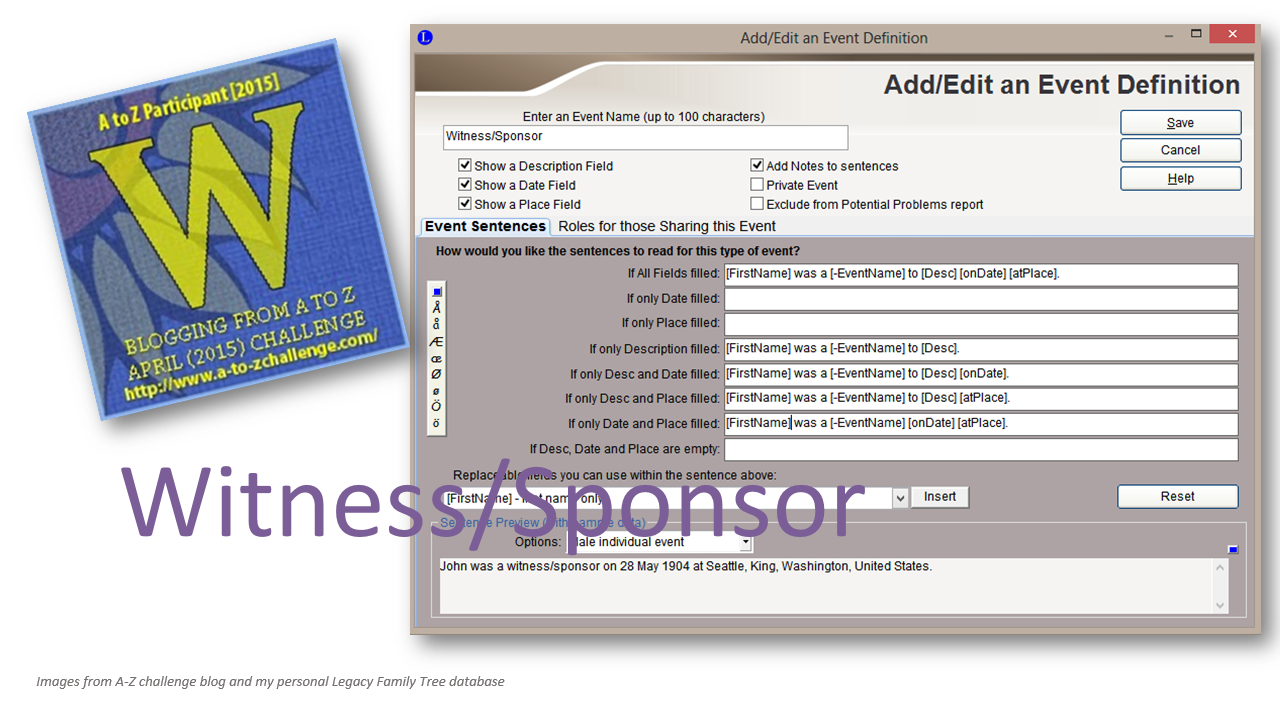
Using witness as its own event in my Legacy family file
They have a role at baptisms and christenings (and throughout the child's life), they sign their names to (among other legal documents) marriage certificates, naturalization applications, wills, and deeds, and often serve as character references in land records and court matters. Today it is all about witnesses (sometimes called sponsors in sacramental documents) and if you are not making a note of them in your transcriptions and your Legacy family file, you should. Why? Because in most instances a great deal of thought went into choosing the witness(es), there were certain requirements and expectations about their roles and, in each instance, they were in attendance at the event - in the role of an observer and authenticator.

Where legal documents were concerned the witness had to observe the signing, be credible, reliable, not have a financial interest, and be able to authenticate the signature of the parties. There were often age and sometimes gender requirements. Where sacraments were concerned, the witness accepted the responsibility to assist with the child's religious upbringing and they had to be at least 16, be validly baptized (usually in the same faith), and could not be one of the parents.

For our baptisms, confirmations and marriages, my family tended to use siblings as witnesses/sponsors. For deeds and other land issues, they often used their neighbors. For naturalization paperwork, they most often used co-workers and the earlier arrivals (who had already been through the process). Until Legacy version 8, witness was a specific event (most likely these individuals were already in my family file as siblings, parents, or married-ins, although I do have a few unlinked individuals). In version 8, the witness designation can be listed as a "role" in the corresponding event if you use that feature.

Legacy introduced a new feature in version 8
where "roles" were included in events/facts

You can add, edit or delete roles and customize the sentences.
Is this a feature you make use of?

Do you make use of witness - either as an event or as a role?

See you back here tomorrow for the letter X!

Saturday, April 25, 2015

V is for Voter Registration


Have you looked in the voter registration rolls for your ancestors? Voter registrations are considered public documents. Perform an online search to find out the public law for the state or locality you are interested in and determine what records have been maintained and what you need to do acquire the information. Some States (most notably California) have placed their records online and they are available through subscription sites or through the State agency. Cyndi's List has 97 locality specific links under the heading Voters, Poll Books and Electoral Records, which includes localities, states and countries with voter registration information. Why not check it out and see if your ancestors registered for and voted in elections. (And a reminder - Cyndi's List is an excellent site for all things genealogy links).

Here is an example from the California Voter Registration Index. As you can see you can find out the name, address, voting district, occupation and party affiliation of any individual who registered to vote. In some Voter Registration Indexes age and length of time at residence are also included. Be sure to take advantage of voter registration information to add to your family's story.


Have you included voter registration as an event/fact in your Legacy family file?

See you back here on Monday for the letter W.

Friday, April 24, 2015

U is for Unknown

always on the lookout for those maiden names
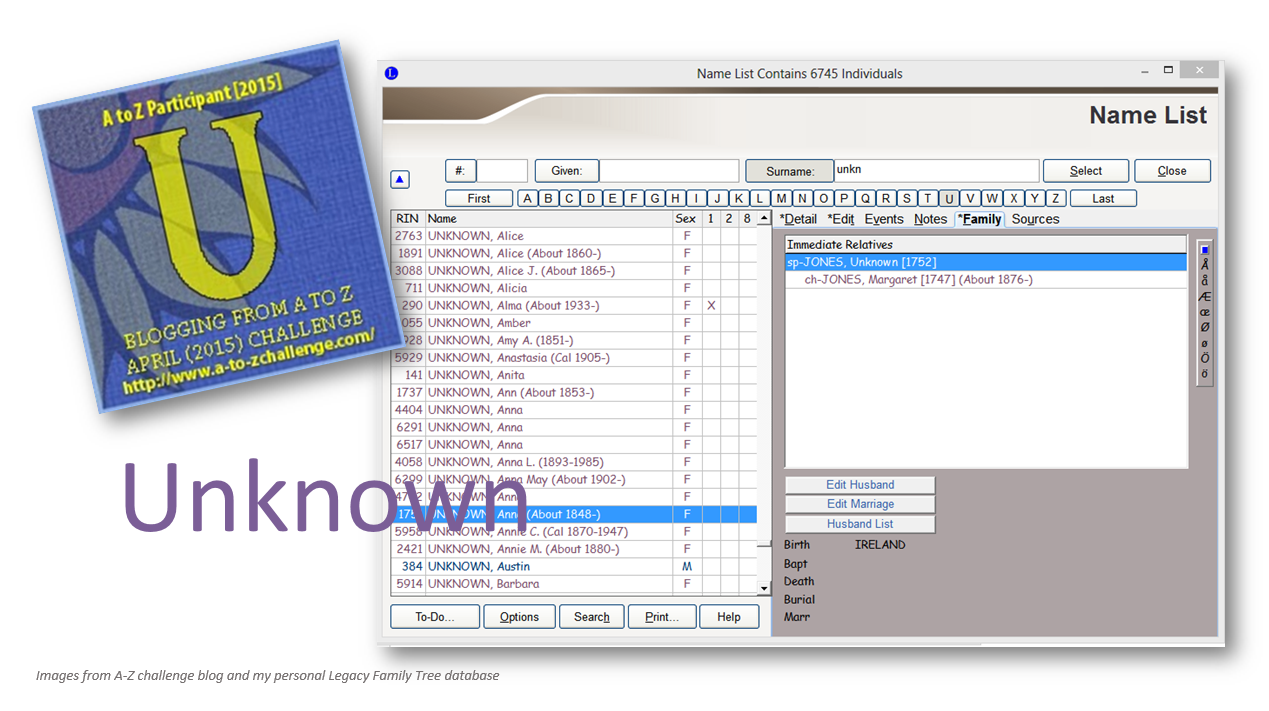
I have 250 females in my Legacy family file with an unknown surname. These are the women who we find in the census or city directory or voting rolls or newspaper articles listed with their married surname. These women are the "married-ins" or the mothers of "married-ins." Oftentimes in newspaper articles they were referred to as Mrs. Harry Smith (not even their own first names were used!). For most of these women, I have not yet found a marriage record or any indication of their maiden name.

I know that many genealogists leave the surname entry blank but I prefer to use Unknown - I know I don't have the surname yet, but I am always on the lookout. I have also made a general note in my Legacy family file that I use Unknown intentionally (and for those whom I don't have a surname) - I would not want anyone to think that Unknown is an actual surname or that all my Unknowns are related (I once heard a presenter tell that story but I really hope she was joking!).

Do you use Unknown to indicate an unknown surname or do you leave the space blank?

See you back here tomorrow for the letter V.

Thursday, April 23, 2015

T is for Travel

Oh the places we go! 
Today we focus on the letter T and so it is all about travel. Do you include travel in your family history? I may be wrong (I often am!) but for most of our families, travel was a nonexistent luxury until the late 20th century. I know that my none of my Swedish, Norwegian, Slovenian or Irish ancestors ever had the means or opportunity to travel and visit family and friends in the old country. They were all too busy working their farms or raising their families to think about travel or (or even) vacations.

I remember when my niece showed my grandmother her scrapbook from a trip to Disneyland and provided running commentary of the week, including the park, the hotel and pool, and the restaurant meals. She then asked Gran (my mother's mom) about the trips she took as a child. Gran responded that times were different when she was young - she worked on the farm as a child, helping with chores and the hens, and any visiting that took place was to neighboring farms where extended family lived. From discussions with my Aunt, I know that although later in life my grandfather (my father's dad) wanted to travel back to Newfoundland, he was afraid to fly, thought the train and boat trip would be too long and difficult, and sadly never ended up making the trip (that might be one reason I made the trip in 2009).

Times have changed - and we can see it in the ship and flight manifests, travel journals and diaries, family scrapbooks and many other records that show recent generations have become travelers. Do you include the information you find about travel in your Legacy database? The major websites have some great records that provide lots of interesting information if you are lucky enough to have adventurous family members. From records I have seen, lots of my extended family went back to Newfoundland for holidays (and oftentimes it was show off their children or to spend Christmas with their family). When I find this information in the records, I include it as a travel event/fact. I have also included our family's travel (my mom always kept a notebook detailing each day of our trips). I love to travel and will take a trip whenever I can. I include travel as an event and write up a bit about each trip (passport stamps, photographs, and references from my journal notes).

Take advantage of the travel event/fact and include information about any trips you or your family members have taken (find those photographs to help tell the story). Was it a road trip across America, a voyage to a distant land, or perhaps a trip back to your ancestors' homeland? Why not share the story so future generations will learn about your adventurous side.
editing the travel event definition - to make it less formal 

finding the travel information
(passenger manifests and customs information)
adds to your ancestor's story
As a total aside, although I use lots of Legacy features, one that I have not made use of is the sharing of events feature. I happened to notice it today while working on this post. Are you using this feature? Is it everything you thought it would be? Does it export well into a GEDCOM, a report or another genealogy program? Just wondering.
a feature that seems better in the idea than the execution
not sold on this one, but could be convinced
See you back here tomorrow for the letter U!

Wednesday, April 22, 2015

S is for SSN and SSDI

The Social Security Act of 1935 - providing for the general welfare of our people
Secretary of Labor Frances Perkins is one of my personal heroes!
Introduced in November 1935 as part of the New Deal program to provide certain benefits to the American people, social security numbers were issued by the newly formed Social Security Board (later the Social Security Administration or SSA). Today social security numbers are also an unofficial national identification number for other government purposes (the most common being tax returns and military service records). Until the 1980s social security numbers were not regularly issued until a person began working; now they are issued as part of the birth certificate application process.

To-date the SSA has issued over 450 million social security numbers, at the current rate of 5.5 million numbers each year (and since social security numbers are not reused, each number is unique!). The nine-digit number was, until recently, made up using a specific format: AAA-GG-SSSS or (1) a geographic area number followed by (2) a group number followed by (c) a serial number. Until 2011 a researcher could make some assumptions about where and when a person made application for their social security number based on the AAA-GG-SSS configuration. Today social security numbers are configured on a completely random basis.

Knowing an ancestor's social security number is useful to confirm the identity of a person's records (oftentimes it was used for not only governmental records but also educational and employment records). The SSA compiles a database called the Death Master File (more commonly known as the Social Security Death Index or SSDI). This database has been made available since 1980 and as deaths are reported to the SSA, certain information from the database is published and can be found at a variety of sites online (caveat: keep in mind that not everyone is in the SSDI):

  • given name and surname 
  • full date of birth
  • month and year of death (now the full date)
  • social security number (now these are redacted due to security concerns)
  • whether the death has been verified
  • last zip-code for residence and/or benefit payment
Including your ancestor's social security number in events/facts is is good practice. Often you will see this number used on educational records, military records, employment records, death certificates and burial records. If you want to acquire a copy of your ancestor's application for social security number (SS-5) and/or claims file, you can fill out SSA form 711 (done under the Freedom of Information Act, subject to filing and fee requirements). These files can have a wealth of additional information, including parents' full names, residences, employment information, and applicant's signature.

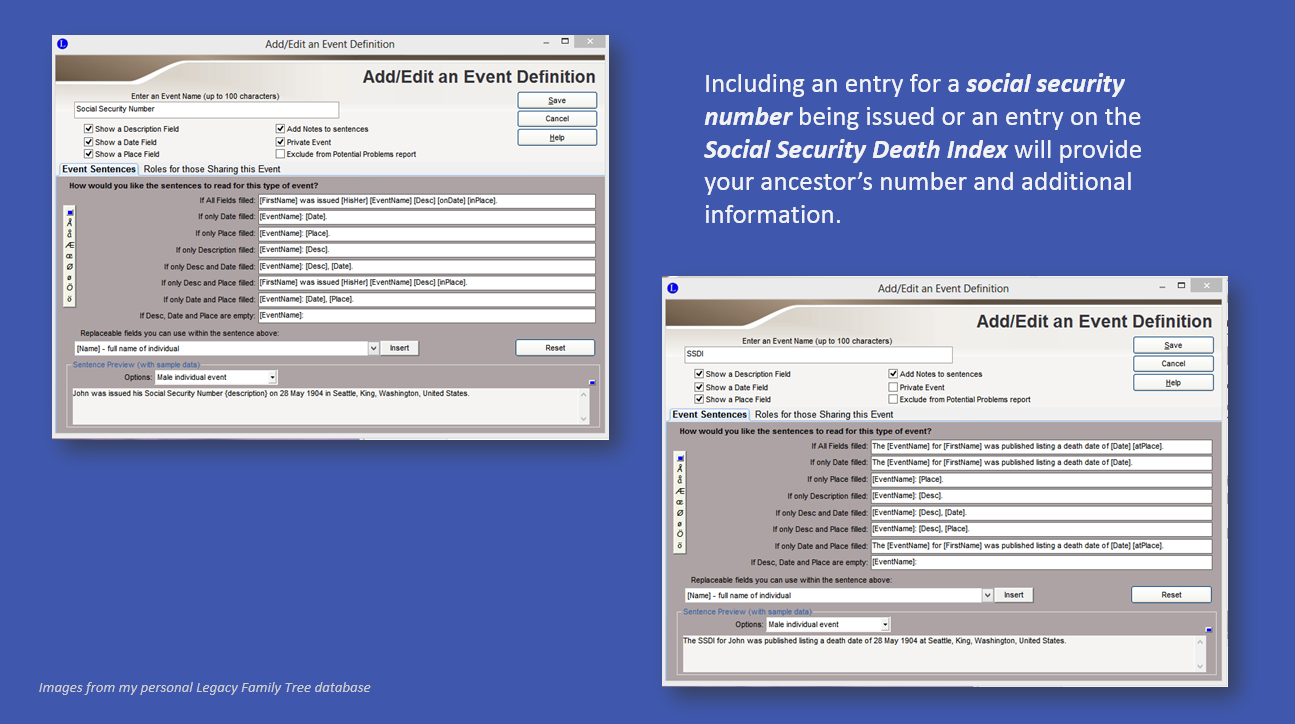
I add social security number and SSDI to my Legacy database as events/facts. I always check my SSDI information against my death certificates. You might want to play with the events/facts definition for these entries. Ask yourself some questions before you set up your event/fact and then make sure to check your work. Do you include the social security number in the description or notes section? If you record social security numbers for living individuals, verify that you keep that information private - with the use of double brackets or checking the appropriate boxes. SSDI information is online. Although it does not raise the same security concerns, do exercise caution when attaching SSDI information to a family tree as living family members might not want this information shared with the general public.

the social security number & SSDI event definitions 
To learn more about social security records research, check out the following links:
Social Security Sleuthing Article by Pamela Boyer Porter

and search the SSDI at the following sites with these links:
AmericanAncestors SSDI search (NEHGS) (be sure to use the advanced search feature)

See you back here tomorrow for the letter T!

Tuesday, April 21, 2015

R is for Religion


so many religions and faith traditions - hopefully you see yours here
Have you included your ancestors' religion in your Legacy family files? Oftentimes where our ancestors originally came from dictated what religion they were and the extent to which they practiced their religion. This is where a knowledge of world history comes in handy. One's professed religion may change based on conquest, political machinations, migration, missionary experience, personal study/reflection of a competing religion, the decision to take up a spouse's religion, or some other unstated reason.

Our ancestors' religion provides us the opportunity to find certain records and follow their life progression. In the Roman Catholic faith tradition the sacraments of baptism, reconciliation, first communion, confirmation, marriage, holy orders, religious life, and burial are all well-documented on the parish and diocesan level. In the Lutheran faith tradition, the Swedish and Norwegian churches kept excellent records on all members of their congregations. When the State was involved (as in Sweden or England) and maintained registers, we have centuries of records we can use to trace our families back several generations. Where a census includes religion as one of its queries (as in Canada or Ireland), we have an opportunity to learn how our ancestors identified themselves. Where political struggle and persecution existed based on our ancestors' religion, we learn how they adapted and/or suffered based on their faith and their oppressors' response to it (as in Germany or Ireland).

In addition to finding and recording the religious milestones, we can also take advantage of the local place of worship's* histories and directories. Perhaps there are schools and social organizations affiliated with your ancestors' religion. Our ancestors' faith traditions oftentimes affected their migration, employment, and personal activities or choices (where to settle, how to dress, what is acceptable to eat and drink, and how to pray, are just a few examples).

add or modify the events so they fit with your family's history

some examples from my family's events include
religion, first communion, and religious life 
The Irish and Slovenian branches of my family tree are Roman Catholic (as far back as I have researched). The Swedish and Norwegian branches were Lutheran (from the records I have found to-date). When my Slovenian grandmother married my Swedish/Norwegian grandfather, my grandmother's religion won out (the result of a few home visits by the Irish parish priest, a direction to enroll my mother in the parish school, and the wide-ranging discussions about religion between my grandfather and the priest which resulted in my grandfather's baptism in the Catholic faith).

What are the faith traditions in your family? Did the choice of religion change over time in your family's history and, if so, why? Have you found any religion surprises in your family tree? If a religion is unfamiliar to you, have you taken the time to learn more about it and incorporate any parts of it into your family traditions? Is religion more or less important to your family today than it was to your ancestors?

* The term "place of worship" used here is meant to include a chapel, church, meeting hall, monastery, mosque, synagogue, temple, or any other place of worship. 

Tomorrow we move on to the letter S.

Monday, April 20, 2015

Q is for Quality

what we all strive for - quality in our genealogy
I am always fascinated when someone mentions how many individuals they have in their family database. In their race for big numbers (or quantity), they forget that research is necessary to flesh out those individuals in their family (quality). That is the difference between being a name collector and a genealogist. Conducting our research in a serious and thoughtful manner (getting it right) is what quality genealogy is all about. So what is quality genealogy and what features in Legacy help us achieve it?

Of course quality genealogy is a bit subjective but I think it means that we dive deep (we are looking for breadth and depth).

  • We want to get those names, dates and places correct
  • We want to ask and answer specific questions
  • We want to build on a solid foundation - understanding the places and times our ancestors lived in so we research based on what was (take off those 21st century glasses and see life through their eyes). 
  • We need to follow the clues, review the documents, and reach some preliminary conclusions. 
  • We need to cite our sources and test our preliminary conclusions.
  • We want to take advantage of original sources
  • We want to continue to build on our strong foundation by finding new information as it becomes available (online and offline).
  • We need to be willing to correct our errors and modify our conclusions when necessary.
  • We need to understand that quality genealogy is a never ending quest!
These are some of the features in Legacy that I use to help me check the quality of my data entry and information. 

potential problems - a great way to check your work

make your list and then check it -
make corrections and clean up your Legacy database

the search feature provides lots of options
to look for what you are missing
focus on one area at a time to help you get through these projects

master lists - a quick scroll through
on a regular basis keeps these clean and tidy

Bottom line - quality depends on me, this is not a once and done project. What Legacy features do you use to help you check your work?

See you back here tomorrow for the letter R.

Saturday, April 18, 2015

P is for Physical Description


Our family reunions are always fun because we make an effort to include some family history mixed in with the visiting, eating, swimming, hiking, and hanging out. I have mentioned the types of activities before, but at our most recent family reunion we also included several short games, a 20 questions quiz, and a team scavenger hunt. It's all done to have fun, learn something about our ancestors, encourage the generations to work together, and award prizes (we are quite competitive and we love prizes!).

We also take lots of pictures and share family pictures during our reunions (and at every gathering we have). One of the reasons is because seeing our ancestors in photographs or having them described to us by the elders (we usually have an open mic and recording system set up so we can share stories and remembrances) gives us a better sense of who they were. We are always amazed when we look at those photographs to see similarities across the generations. Oftentimes the younger children want to know who they look like or who they take after. Whether it is the hair coloring, the freckles or lack thereof, the height, the bone structure, the eye coloring, or any number of other features that make up a physical description - it is fascinating to go through old photographs to check on resemblance.

We can find physical descriptions from a number of sources - passport and citizenship applications, military registration and enlistment forms, family photographs, newspaper articles, medical records, and obituaries, just to name a few examples.

I like to personalize my entries (use given name) and
here the notes are included as part of the sentence (customize!)
Do you include physical description as an event/fact in your family history database? Now is the time to check out those photographs and ask your elders to describe people in your family file so you can learn more about your ancestors. 

Have a great weekend and I will see you back here on Monday for the letter Q!

Friday, April 17, 2015

O is for Organization


Our ancestors were joiners - and they joined organizations. Whether they were involved in faith-based groups, labor unions, historical associations, garden clubs, political groups, alumni associations, charitable groups, parent-teacher organizations, business or farm associations, or fraternal organizations - they banded together with other like-minded people and were part of many different communities. Have you included this organization information as an event/fact for your ancestors? Learning about their voluntary activities often helps you discover more about what was important to them and how they chose to spend their time.


Listed above are a few examples of the various organizations that my family members have joined (as well as the key terms for organizations). Oftentimes you will find these organizations listed in newspaper articles (especially local community newspapers) and obituaries. Whether they were simply members or held leadership positions - this is an opportunity to learn more about your ancestors.

whether they were members or officers,
whether the organization was society, union or ethnic based,
their choice of organization tell us a bit about their lives

check out the organizations mentioned in obituaries

When I found this obituary I had no idea what the Third Order of St. Francis or the Eagles Aerie No. 1 were. A quick search on Google brought up a wealth of information and I had a much better sense of my grandfather's religious and charitable nature. Tell more of your ancestors' story by finding out about the organizations to which they belonged.

See you back here tomorrow for the letter P.

Thursday, April 16, 2015

N is for Namesake

one of those events/facts that provides some great stories!
Most families have favorite given names that are passed down from generation to generation. Many ethnic groups had naming patterns and oftentimes understanding that pattern provides clues, or names to look for, when conducting your family history. Are there given names that are used through the years in your family file? If not, how and why were given names chosen? Do you include that information in your Legacy family file?

customize this event/fact and include only what you want
This is one of those great interview questions to use with family members (and an easy one to discuss at family reunions). One of my cousins was named for his mother's favorite actor(!), another cousin's name is heaven spelled backwards, a niece is named for my grandmother, a brother's middle name is for my father's best friend, and an uncle is named for my grandfather's favorite brother.

you might be surprised by what you learn!
Once you get your family members talking you will hear all sorts of stories. Perhaps the parents were trying to choose a name that would honor both sides of a family, or not choosing a name because of strong negative feelings about it. Perhaps they chose a name that went back to their roots (very common in my Irish and Scandinavian families), or chose a name because it was unique or had not been used in the family before.

If you haven't done so already, why not add namesake to your Legacy events/facts. It is another thread to add to your family history tapestry.

Wednesday, April 15, 2015

M is for Military Registration

military registration - a wealth of information

What's not to love about the event military registration? To-date, I have 132 military registration entries (you can find that result from the title "all those who use the event definition"). The information taken from registrants varies by conflict and forms, however by World War I and World War II the forms (when properly filled out) contain a tremendous amount of material. These military registrations have pointed me in the right direction on full names, birth date and place, occupation, place of employment, name and address of someone who would know the registrant's whereabouts (often a spouse or parent), the signature of the registrant, and a physical description. Definitely look through to the second or reverse page for this information.

Be sure to read about the records and learn the important dates to make your searches easier. I have only begun to explore these military registration records, but make a point to include military registration in your Legacy events/facts. Keep in mind this is simply registration, which was required of all males between certain ages - it does not mean they enlisted or served in the military (that is an entirely different set of records - think of it as learning the rest of the story).

I have customized the event definition - play with yours until they work for you.
examples from my Legacy database
Shown above are examples of military registration entries from the Civil War, World War I and World War II.


As you can see - names, addresses, education, occupation, and physical descriptions can add to your ancestor's story. Be sure to check out military registration for all those great clues.

See you back here tomorrow for the letter N!

Tuesday, April 14, 2015

L is for Land Records

L is for Land Records - whether held on the local, county, state or federal level, one of the most interesting record sets is land records. So many of our ancestors came to the United States with very little. Unoccupied land was plentiful, congressional acts - specifically the various homestead acts - made it possible to purchase land for a pittance. Hard work and perseverance made it possible for families not only to survive in their adopted country, but to thrive.

My 2nd great grandfather's experience with the 1862 Homestead Act was played out countless times with people from all over the world who came to the United States and changed their destinies.

Both James and Ellen were from Ireland, came to America
and made a life for themselves and their children.

With 2 payments totaling $18.00 James and Ellen owned 160 acres
a farm that remains in the family today.  

I can only wonder how 8 people lived in a house the size of my bedroom
and yes improvements continued over the years!
Do you have any homestead act properties in your family? Have you researched those farms and properties? I had the opportunity to review the original land records for James Joseph Murphy's application and grant at the National Archives in Washington, D.C. Sitting in the reading room and reviewing the original land records was a thrill. If you are lucky enough to have homestead land records in your family history, do the necessary research, touch a piece of history, and be enthralled by the story of your family who did their part to build the farms of America.

See you back here tomorrow for the letter M!


Monday, April 13, 2015

K is for Kinship


Ah, the ties that bind. Kinship - is connecting the generations that are blood-related. That is what genealogy is all about. We preliminarily determine kinship based on what the documents tell us (in the sense that they can speak). These are the names and connections listed on birth certificates and marriage registers. No doubt many of us have found errors or outright lies in our family genealogy. In this brave new world of DNA studies, we are digging a bit deeper and testing those kinship connections.

We use our genealogy database software to show our kinship connections - whether that is in the family, pedigree or descendant view. And we can also use the relationship settings and calculator to determine just how we are connected to others in our database. This is what it looks like in my Legacy Family Tree database.

the family view and setting relationships (found in tools)

a relationship report can help you see the kinship connections

Of course, Legacy provides all your connections in this report, so if you want to use advanced tagging to limit your connections to the direct line option, you have that choice. Do you use the set relationship, relationship report, or relationship calculator features in Legacy?

See you back here tomorrow for the letter L!

Saturday, April 11, 2015

J is for Journal


Although I love my laptop and smartphone and all the convenience that software programs and apps give me, I find that when I am thinking, dreaming and planning - nothing beats paper and pen. At the start of 2015 and in an effort to get better organized, I started an experiment - keeping track of my day to day "stuff" in a notebook and using the "bullet journal" approach. Why? I was finding that it was too easy to swipe and snooze tasks and deadlines on my apps! So J is for Journal - and let me tell you why.

I keep all types of notes in my bullet journal (and because I was not sure whether this idea would work, I purchased a graph notebook from Office Depot - nothing fancy here since I am throwing it in my bag every day). I started out with a calendar, index and daily page - most everything goes in the journal. That includes daily tasks, shopping lists, money spent, ideas, proposals, notes from a seminar, telephone conversations, books to read (and books read), personal items, the amount of time it takes to get through projects and the order I plan to do them (giving me a better sense of how I spend my time).

Right now I am using the bullet journal for my personal and genealogy life. The upside - theoretically everything is in one place (day by day) and I can go back through my journal, read previous entries and find stuff. In practice and four months into this experiment, I am about halfway there (although it was my go-to notebook for RootsTech/FGS - I was perfect every day!). I am doing a much better job of  jotting things down in my bullet journal, making some notes for the next day each evening, and then checking in and checking things off during the day.

Don't worry about perfection - just put pen to paper!
I actually enjoy this old school approach.
My actual genealogy research is still kept on either (1) letter size paper so it can be put in the few physical notebooks that I keep or scanned to go into my computer files OR (2) my OneNote filing system for all my online research and written reports. I don't think I will ever be that person who goes completely paperless because I like the feel of and conscious attention that I give to real books and pen and paper too much. I do appreciate the tremendous amount of research that I have on my computer and the ease of online research and annotating PDF versions of books and articles, so this seems to be a best of both worlds solution.

One of the uses of my bullet journal is for my thoughts, ideas and inspiration - and two great sites to help your mind wander through those areas and to write or journal a bit about yourself, your family and your family history are:

  • The Book of Me, Written by You - a great personal writing project with prompts. Check out Julie Goucher's website and associated social media pages and jump right in.
  • The "When I Was Young" Geneameme - a clever idea from Alona Tester. She has 25 questions for you - if you get started answering them you will be able to record some fond memories for yourself and your family.
Check out these two posts - they will get your creative juices flowing!

Do you journal, either for yourself or your family history? Did any of your ancestors keep a journal or diary? If so, how have you preserved and shared it?

See you back here on Monday, for the letter K!
Have a great weekend.

Friday, April 10, 2015

I is for Immigration


I think the reason I enjoy genealogy and family history as much as I do is that I love history and geography. I also enjoy reading, researching and puzzles. All that comes in handy with genealogy, especially when your ancestors are the more recent arrivals to Canada and the United States (late 1800s and early 1900s). With Irish, Norwegian, Slovenian and Swedish in my family tree, I get to spend quality time researching emigration and immigration records! The registers, indexes, ships' manifests, arrival documents, newspaper articles, citizenship paperwork, photographs and family stories all tell the tale of travel from the Old World to the New World.

I use both emigration and immigration events/facts with my Legacy database. One of the reasons is that it is quite easy to find emigration records for my Norwegian and Swedish ancestors. There are great church and government records that kept track of the people and many times those leaving were given copies of their church records to deliver to their new parishes/churches on arrival in the United States.

the emigration register and the immigration record

whether you use the list or the report version of the chronology report,
be sure to add all the information and then go beyond the documents

The emigration records are also known as the "leaving" records. I find it useful to find out where they left from, where they might have stopped along the way (early travel was often through England - arriving on the east coast, traveling by train to the west coast and then traveling across the Atlantic to Canada or the United States). The immigration records are also known as the "arriving" records. Depending on when and where your ancestors arrived, the records can be next to nothing or lines in a ship's manifest, images or photographs and receipts.

  • Since my 3rd great grandfather left Ireland for Newfoundland, there was no immigration paperwork - due to the timing, he was a British subject so it was just considered travel from one part of the British Empire to another.
  • When my 3rd great grandmother left Ireland for the United States, she and her daughters first immigrated to Canada - the passage was cheaper and there were no financial or medical exams, again they were British subjects. I know they traveled through the Great Lakes region but have no found their papers yet!
  • When my 2nd great grandparents left Sweden (in their 50s) with their grown children, they arrived in New York and knew exactly where they were going - Wright County, Minnesota - where several of their neighbors and my 3rd times great granduncle has already settled and purchased farmland. Their records leaving and arriving were easily found.
  • When my 2nd great grandparents and their two young children left Norway they traveled to Canada first and months later continued on to the United States (again headed for Minnesota). Their records for leaving and arriving were a bit trickier until I found the Canadian connection. 
  • When my great grandparents (individually and unbeknownst to each other) left Austria/Slovenia for the United States, they each arrived at Ellis Island (and then traveled by train across the country to Washington - enclaves of Slovenians and coal mines). Finally I got to do some Ellis Island research - I even have pictures of the ships they traveled on.
  • When my grandfather immigrated to the United States from Newfoundland, he did so twice (his first arrival through Boston, Massachusetts was not done through the proper channels; his second arrival through Minot, North Dakota was his golden ticket!).
  • My grandmother who was born in the United Stated, immigrated to Canada in the early 1900s with her father and her siblings (a story for another day or letter!).
Between my direct line ancestors and all the extended family, we have examples of emigration and immigration records from early on through the 1940s. Be sure to document the immigration story of your ancestors - and go behind the documents. What did the trip cost, how did they raise the funds, where did they leave from, who did they travel with, how long did the trip take, how far a distance was the trip, what was the ship or train or plane like, where did they arrive, what were their first months like, did they stay in contact with family at home, did they become citizens, did they learn the language, did they return home? Learning about their immigration story will make you even more grateful to them for making the trip! 

Tack - Takk - Hvala - & Go raibh maith agaibh to my Swedish, Norwegian, Slovenian and Irish ancestors for making the trip, changing your lives, and meeting up once you arrived - we are here because you got on those ships!